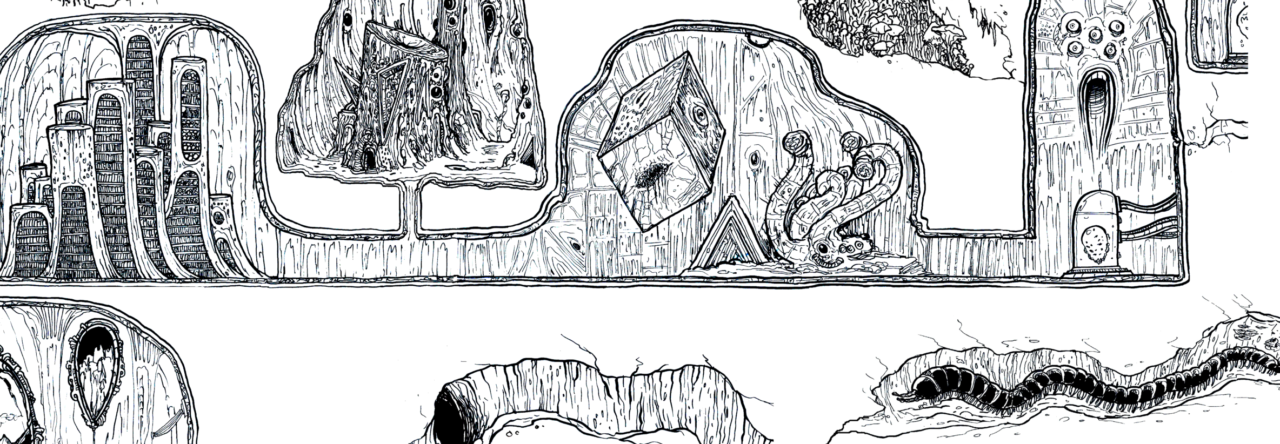
There’s been some interest recently expressed on Discord and Google+ (before its demise – may it rest in peace) as to how I run this campaign. This is the first of a series of posts on how I approach an urban D&D game. It is, of course, not the only way to run this sort of thing – indeed, I suspect I rely rather less on a lot of common conventions for urban adventuring, most notably by eschewing procedural content-generation methods. I’m going to start by describing the kind of game I aim to run, and then I’ll talk about the procedures and techniques I use as a DM to create and sustain that game.

Urban Sandbox
Sandbox adventures frequently involve sprawling wilderness landscapes, hexcrawls, and similar structures. My goal is to take the feel of openness, freedom, and agency associated with typical sandbox play, but largely confined within the space of a single city. While some adventures have taken the characters outside of Hex (the main city in this game) to places like the wintry wastes of Troll Country, the Gothic province of Varoigne, the guts of the gigantic whale Genial Jack, and the depths of Faerie, the game is centred in and around Hex. In this sense, I am simultaneously adopting and inverting the approach of a West Marches campaign, which aims to cultivate an overarching environment, but also warns against the perils of “town adventures.” Hex is nearly all town adventure, but the town has been transformed into an adventure-worthy space.

I also DM for a large group – currently I have 10 semi-regular players. Because players come and go, skipping some sessions and attending others, the “plot lines” of the campaign are incredibly loose. There have been significant, ongoing events happening in the campaign world: Erubescence’s ambitions, the machinations of the Griefbringer, Hex’s ongoing labour struggles, a conspiracy quietly unfolding in the background which my players are now unraveling. And, likewise, there is a very rough “main quest” which the party dips into: their search for the mysterious volumes that comprise the Organon of Magic, ostensibly for the ancient archwizard and brain-in-a-jar, Master Melchior, whom much of the party actively distrust. Mostly, though, the game is a patchwork of disjointed episodes, a picaresque series of heists, vendettas, delves, and personal quests. This disjointedness is a feature, not a bug; while the players will sometimes pull on a plot thread and see where it leads, we never follow one storyline too long or too doggedly. They drive the “story” such as it is, choosing where to go, what to do, and what interests them most.
The closest literary analogues for this sort of game are Fritz Leiber’s Fafhrd and the Gray Mouser stories, as well as Terry Pratchett’s Discworld novels, where a cast of recurring characters are swept up in a series of adventures only loosely connected to one another. Hex has other fictional forebears – Sigil, Cörpathium, New Crobuzon, Camorr, Ashamoil – but structurally, Lankhmar and Ankh-Morpork loom largest. Sir Arthur Conan Doyle’s Holmes stories also have something of this – London in Doyle’s writing sprawls Gothic and gaslit, a labyrinth of mysteries and fog which the protagonists wander, embroiled in a disconnected sequence of macabre incidents and misadventures.
In designing Hex, I made sure to have the city open onto various other worlds and nested structures. Setting it atop an ancient, gigantic city, I made it adjacent/continuous with a megadungeon that serves as a convenient adventuring location; that dungeon is thick with impossible spaces, pocket dimensions, and portals. The idea is to present such a smorgasboard of possibilities that the players never get bored and always have a host of options as to where to go next. I want to evoke a sense of rich, infinite adventure.
Baroque DMing and Urban Space
At one point someone on Google+ (I think it was Patrick Stuart?) described what I was doing as a kind of counterrevolution. While I run a 5th edition game, philosophically I borrow a lot from old-school D&D – my game features the potential for fairly high lethality (in practice, death is pretty rare because my players are cautious), open-ended challenges, creative problem-solving, an emphasis on an immersive setting, and a prioritization of exploration and emergent storytelling over “narrative.” I prefer puzzles to “balanced” combat, out-of-the-box thinking to skill rolls, rulings to an excess of rules. The one old-school standby which I tend to eschew is procedural generation. I’m not oppposed to random tables inherently, and I do use some occasionally both of my own devising and otherwise, but I far prefer to have prepared as much as possible beforehand. The template I’m looking back to here is City State of the Invincible Overlord, where the city is entirely mapped and keyed.


In navigating the city, I want my players to feel as if nothing is being invented on the spot – the setting should feel as if it exists independently of them, and they are exploring its secrets. It should be suffused with interesting details and a sense of grandeur and verisimilitude. My goal is to produce a feeling of absorption and fascination, an experience of actually navigating a real-feeling, mind-independent space.
This is, in large part, why I wanted a physical, detailed map of the space, so that the players could see the city sprawling before them. It’s a common dictum that this is the wrong way to run cities, the idea being that maps constrain the imagination and pin down what could be a fantastic space too much. In drawing the map, I tried to create a visually appealing and chaotic space that enhances rather than undermines a sense of mystery. Yes, we can all see the Tower of Whispers on the map, but what could be inside such a bizarre spire in the middle of the city? Why is there a giant crater in the middle of the southern half and why haven’t people rebuilt over it? Is that a gigantic dragon statue broken into peices in the lower left-hand corner? And what is with the giant trees? I want players to look at the map and feel excited to explore. And, of course, there’s a hidden space as well – the Old City below, the massive sprawl of tunnels, sewers, caves, and ruins that the PCs have only partially explored.
The aesthetic I’m going for, then, is explicitly a maximalist one – in some ways, “the Baroque” is a good descriptor for what I’m attempting.

Historically, the Baroque was aligned with a Catholic counterrevolution against Protestant austerity and simplicity; Baroque aesthetics strove to evoke a sense of awe and extravagence, with plentiful, ornate detail, complexity, sensuousness, emotion, and drama, in contrast to the dour severity that often characterized the Reformation. My goal in DMing is to create something of this vertiginous rush of complexity and detail, while still making the experience intelligible and player-driven. Indeed, player agency here is absolutely key: it’s vital that the players feel they can explore wherever they wish and find something engaging to interact with. Otherwise, the setting would end up feeling like a very pretty but ultimately flat series of backdrops that the PCs roll by on their way to and from pre-scripted plot points. To ensure this doesn’t happen, it’s important to distinguish between prepping and planning. The former is about providing a detailed, thought-through environment for players to explore and inhabit; the latter is about aiming for a specific narrative arc or set of story beats. I do a ton of the former and almost none of the latter.


During play, I keep the Hex map itself spread out in front of players at all times, so they can see where they are and how locations relate to one another spatially. I don’t always go street-by-street in describing everything as they move around the city – this would make the game very slow – but I do “zoom in” to a district level, street-by-street, once the party arrives in a given neighbourhood. I think of it a bit like how Planescape: Torment (a huge influence) handles city movement: there’s a map with districts, you click on one, and then you “zoom in” to that particular district’s individual streets.


If the party decides to “zoom in” on a specific location, I always have something ready – I’m not suddenly grasping for details that aren’t present, and forced to make something up or generate something randomly that wouldn’t be as interesting as something I thought up ahead of time. I’ll have descriptions of each street, NPCs worked out, encounter tables when appropriate, and often some oddity or other the party could choose to interact with, like a weird homunculus wandering about outside a condemned building or a vagrant spellcaster painting magical murals on a wall.

Consequently, I rely on what I think qualifies as extremely heavy preparation – again, prepping, not planning. What I’m aiming for here is what Joseph Manola over at Against the Wicked City identifies as the essential quality for good roleplaying books: “the contents need to be something better than you could come up with, unaided, simply by following cliches and/or random madlibbing and/or coming up with irrelevant filler.” Whenever I write something down, it needs to be better than something I could come up with on the spot at the table, better than a cliche, and not irrelevant filler. There is no Powered by the Apocaylpse-style collaborative setting-building here: the PCs do have backstories and I do incorporate those into the texture of the world, but I don’t ask them for details about a scene or give them opportunities to shape the world outside of the actions of their characters. Those actions are consequential, sometimes massively so, but they are bound by an in-universe logic and constraints. Similarly, I don’t rely on random die-rolls or other procedural heuristics or techniques to generate street-maps, encounters, or NPCs. It must all get planned exhaustively, so that when the players stray from the beaten track the spaces feel lived-in and authentic and just as interesting as the parts I expected them to visit. This means drawing a crazy-detailed city map with every street and major landmark indicated, and producing extensive notes for every likely adventure location – I’m currently sitting at about 270,000 words for a total of 38 sessions so far (yes, I’m behind on recaps).

Obviously this means a lot of writing and drawing. But, as the DM, this is to me a huge part of the fun: I don’t think of writing adventure notes or drawing maps as work. I have other hobbies and leisure activities and things to do, of course, and a job that takes up a lot of my time, and I do occasionally take hiatuses when things get too busy to keep up with the campaign, but I find the act of creation and then sharing that creation with a group of people incredibly rewarding – so this preparation really isn’t a chore. All that said, I do use certain procedures to make this easier on myself.
Pre- and post-play Procedures
I organize the campaign using groups.io, a wonderful email group service with a lightweight, easy-to-use interface and the ability to quickly and painlessly distribute polls to those within a group. Before every session, I post two polls: the first is a scheduling poll to see who can play when, and the second is a poll of broadly defined adventure possibilities, usually picking up on things the characters did in the previous session, or sometimes reflecting events that have transpired in the setting. Some of these are ongoing, so if the party neglects them, they’ll change: for example, the endless winter caused by the Harrowgast in some of last year’s sessions was something the players ignored in the polls, until rioting in the streets and famine made them take notice. Genial Jack’s nightmares are another example – the players heard rumours that Jack’s sleep was disturbed, but it took them a couple of sessions to look into it, and if they hadn’t, things would have gotten worse and worse.
The polls function a bit like a quest log or journal in a computer roleplaying game, but many of the available threads are generated by the actions of the players, rather than simply representing “available jobs” (though there are some of these too). In a recent session, for example (one not yet posted to the blog), we picked up on the backstory of Caulis the homunculus, whose dead creator had saddled the character with a demonic debt – something the player had included in their back-story since character creation. In another, Comet’s player had mentioned the waspkin was hanging about in the Feypark to avoid harassment by the Crowsbeak Thieves’ Guild, and was getting to know the plants and animals there; this led directly to a fun little adventure where the character shrunk down to rodent-size for some Redwall-style medieval animal hijinx. In the two-part Château de la Marche adventure the party explored a character’s familial estate and faced off against a villain they’d failed to kill in an earlier adventure. In our most recent session, Yam’s player had a clever idea for keeping the reality-warping Book of Chaos safe, and so I wrote an adventure planned around the idea. The idea here is to avoid making the characters passive, but to view them as active agents in a world that reacts to them; the poll, which players themselves can comment on or add to, simply lets me see which direction they’re headed.

Polls indicating a rough plan for future sessions let me prepare adventures and areas for exploration more extensively. In this case, a detail I’d improvised in the previous session led to option 6, which tied for the most popular option. In discussion below, we decided to go for option 6 over option 1…

Of course, once we arrive at the table, the party is free to go anywhere. But having a broad direction discussed and decided ahead of time not only lets me prep the areas we’re going to play in more extensively, it keeps a big group of players on track and avoids having to recap every single thread of the unfolding game every time we sit down to play. There’s no railroad, and no pre-scripted story, and no invisible walls that keep players stuck in a single area, but there is a consensus going into each session of what the party would like to accomplish. It also means that players who can only come every few sessions – or even those who stop by once or twice a year! – can jump into a session easily without being paralyzed with too many choices.
After each session, we use an extensive Google spreadsheet to track experience, which also shows how much XP each character needs to level. This, along with the session recaps I post here (massively facilitated by the notes my players take), helps a big group to maintain a sense of cohesion. Those who’ve missed sessions can read the recaps to catch up on what they’ve missed and make sure character sheets are up to date.
Adventure Hooks
While it’s always up to the players where they want to go and what they want to do, and I try to plan sessions in reaction to what the players have done previously, I do have some stand-bys for common adventure hooks. These include:
- Adventures related to a PC’s faction. Most of the PCs are members of an arcane university (there are eight: Fiend’s College, Umbral University, the Académie Macabre, the Citadel of the Perptual Storm, the Institute of Omens, the Warders’ Lyceum, the Metamorphic Scholarium, and Master Melchior’s School of Thaumaturgy & Enchantment), a thieves’ guild (the big ones are the Crowsbeak and Ravenswing guilds), religious organizations (the chief gods of Hex being the Archdemons, the Unspeakable Ones, the Mother of Spiders, the Magistra, the Charnel Goddess, the Elder Trees, and the Antinomian), and other factions, like the Faerie courts or wizardly cabals.
- Adventures related to a PC’s backstory. Most of my players wrote brief backstories with little adventure seeds scattered throughout them, providing plenty of opportunities for adventures.
- The “main quest” items they’ve been hired to recover all have adventures associated with them.
- Calamities and other events invite PC participation. The endless winter, Jack’s nightmares, looming war.

Running the Game
During an actual session, I more or less proceed as follows:
- Players arrive. Drinks are poured, food is ordered, socializing commences until everyone is present.
- The game starts. I start a playlist I’ve prepped beforehand on my Google Home, usually consisting of various ambient/videogame soundtracks.
- I go around the table and ask each player what their character has been doing between sessions. Because we play a very episodic game, it is relatively unusual for the group to pause “mid-adventure.” Each player takes 3-5 minutes to respond, so this usually takes beteen 15 minutes and half an hour. For example, Armand’s player has a series of strange botanical/alchemical experiments the character is undertaking.
- We segue into what I think of as the “preparation phase” of the game. At this point I will remind the players gently about the objective they voted on before the session. Then I step back and let them play out a quick scene, usually in a tavern or in one of the houses of the characters, as they plan whatever venture they’re undertaking, be it a dungeon crawl, a heist, a political meeting, a wilderness journey, an auction, a trip into the nightmare-haunted mind of a gigantic primeval whale, etc. This usually takes a few minutes, sometimes longer if there is substantial disagreement among the party members about how to proceed.
- After the preparation phase is complete, we launch into the “main phase” of the game – however the players want to tackle it. Generally this wraps up by the session’s end, but new adventure seeds will be uncovered, ideas had, conspiracies unmasked, etc. Sometimes the party needs to pause midway through, but this is rare. I’ve become fairly adept at judging how long it takes for a given adventure to be completed. During this phase, I periodically try to check in with everyone – with a big group, its easy to sink into silence and let others take the lead.
- The session concludes, and we often briefly discuss what we might do next.
- I use groups.io to notify players of XP, update the spreadsheet, and post polls for the next session time and objective. Players discuss any possibilities and hash out a rough plan of what to do next session, ask questions about gear, leveling, etc.
Further Notes
There’s a partially justified objection, both in some OSR circles and in indie/narrativist/story-game circles, of a very prep-heavy style of play, and most versions go something like this: if you prep too much you get precious about your setting and/or your story and will inevitably railroad players, and prep-heavy DMs are usually “frustrated novelist” types who really wish they were authors telling their own story rather than referees of a game. There’s real wisdom here – this is why people dislike Pathfinder adventure paths and bloated AD&D adventures and all that kind of thing.
However, again, heavy prep does not necessarily entail pre-scripting or planning a plot. Indeed, by extensively preparing locations and NPCs, I find myself feeling reassured at the table. I am also never gripped by panic of a blank space on the map – if the players decide to go somewhere I hadn’t envisioned, odds are I have at least some notes for what’s there, and enough modular material (encounters, adventure seeds, weird happenings) that I can make the area feel interesting enough that it doesn’t become obvious when the players are leaving the rough path I envisioned for them.
None of this makes good improvisational skills superfluous. I make things up all the time, improvise almost all NPC dialogue, and of course embellish my notes with invented details. Inevitably, the players will do things I don’t expect and come up with plans and ideas I never would have imagined. Having a wealth of setting information on hand lets me roll with the punches. Prepping locations and NPCs rather than plots means that there’s no “script” to deviate from and thus no “wrong” way for the players to proceed.

There’s also a long list of things that I gloss over or just plain don’t care about when I’m actively DMing a session:
- Precise timekeeping. If the players ask, I tell them a time, and when it’s relevant to the adventure, I keep a loose sense of what time it is in a session, but otherwise I just don’t care.
- Precise book-keeping. If we were playing a gritty wilderness survival game or a pure horror game I’d care much more about this, but since the party is in a rich metropolis, I always assume they are well fed and have access to supplies. They still need to buy specific equipment, and sometimes we will roleplay shopping, but a lot of this gets done between sessions. If someone forgot to buy arrows for their bow and would really like to be able to shoot things, whatever, we’ll retcon that they bought them. With a group of 6-7 players per session, it just doesn’t make sense to spend time roleplaying merchant encounters excessively or fussing over exactly how many days of rations they have left.

- Rules discussions and minutiae. I and my players are very much “rulings not rules” people. They trust me to make fair decisions. Combat in the game is common but not the main activity most of the time, and I play fast and loose with 5th edition’s fairly flexible rules system, interpreting PC intentions and actions generously, and making quick calls when needed. I can’t remember the last time there was a rules dispute at the table, but if someone discovers a rule that got ignored which might have benefited them or something, I’ll give out Inspiration as recompense.
- Balance. I regularly give the players access to magic items that are pretty powerful tools for characters who are at this point mostly 4th-6th level (like the Head of Granny Midnight, the Portal Chalk, or the Rod of Mind-Swap). I also regularly throw monsters at them that are way above their recommended CR. They’ve played enough with me to know when to run and how to play intelligently without getting killed. This is a pretty standard principle of sandbox play generally, but it’s one I try to lean into.
So, there you have it – the procedures and philosophy underpinning my Hex campaign. Let me know if there’s anything you’re curious about – I’d be happy to answer any questions. I plan on writing more posts like this in the future fleshing out additional details both of how I DM and how I design dungeons, cities, and adventures.


 Comet tried his hand at several cage-fights, winning several and surprising the crowd greatly; Sister won a round of Leper’s Dice, coming away with an extra pincered limb, won from a karkinoi gambler. The group then turned to the exciting shark-races, held in tubes of sea-water winding through the Coils. They placed bets on sharks like Gnasher, Beauty Queen, Mister Smush, Blue Lightning, Bloodlord, and Her Eminence – as well as a mysterious shark, “Carl,” entered by Yam, in fact a subtle illusion the mischievous gnome wizard was conjuring. Bets made, a tiny automated submersible was placed in the tube, leaking blood; the sharks, gnashing their teeth, were off. Yam’s illusory shark won the race handily, earning the gnome an impressive number of dubloons, Jackburg’s currency. The race-attendants began inspecting this mysterious new shark, but the party was saved by a sudden tremor, the “ground shaking,” glasses shattering, cards and chips flying from tables. It was as if all of Jack were quaking, an a monstrous groan was audible, the whale himself crying out in the night.
 When the group had picked themselves up, Sister sought out Parthenia Quell, the Navigator who was celebrating with the Variegated Company, and daughter of Sister’s former lover, Adam Quell.
 his twisted left arm, and his slug-like lower body, mutations caused by the alchemical poisons Hex introduced to the water of that city during one of its many wars – sold a variety of salves and oils, including medicinal tinctures; Yam purchased some “salve of sentience,” which animated any object it was rubbed upon, like furniture polish.
 Miri, the Sage, recognized the memory instantly – the Great Fire of Inner Jackburg, a conflagration caused by the release of a clutch of wyrmlings, accidentally hatched in the marketplace. The wyrmlings were eventually charmed by a group of visiting enchanters from Tetractys, but the death toll was in the hundreds. She quickly explained this to the party, even as swooping shapes flitted through the fire and smoke – the wyrmlings, recreated in Jack’s dream, spreading fire everywhere.
 The party leapt into action, Sister flapping her wings and taking to the air in search of the assassin firing at the enchanters. The wyrmlings hurled fire, scorching Miri, who counterattacked with magic missiles. Yam, as the Demiurge, manifested a chain around one of the wyrmlings as it swept by, andmanaged to subdue it; Caulis cast a spell to charm one of the beasts, while Alabastor used a phantasmal force to subdue another.

 They touched down on Chelicerae street and hurried to door 13; Alabastor picked the lock, then ducked a poisoned crossbow-bolt rigged to hit whoever opened the door.

 Captain John “Deathtail” Winters, one of the auctioneers, hissed. “That den of horrors?” the ratfolk Captain chirped. “An ill-favouered labyrinth, infested with scum of the vilest sort.”
 Entering the pyloric stomach, the air changed, becoming colder, sharper. The smell of ancient dust and a strong waft of stomach acid rose to meet the party. The district was built atop and around a series of pallid stone monoliths that loomed like many-eyes ghosts staring up from below, twisting ramps and walkways linking them. The newer structures accreted to these cyclopean towers were made from the same flotsam and jetsam as the rest of Inner Jackburg, but here something about their construction was different, the angles subtly off, the bridges too crooked, the doors and windows askew. Therewere snarls of shantytown that the adventurers’ eyes slide off, making them dizzy.
 A cluster of scaly, serpentine creatures like monstrous eels blocked the alley’s exit, their puckered mouths drooling, piscine eyes wide and hungry.
 Captain Deathtail. Illustration by Caulis’ player,
  Sister’s Strike. Illustration by Caulis’ player,
  Ice Shark. Illustration by Caulis’ player,
  Chef’s Special. Illustration by Caulis’ player,


 The party spoke to the owner, Captain and Curator Nodus VIII, a polypoid himself – dapper, debonair, and exquisitely mannered, eighth of his line, some fifteen-hundred years old, with the finest taste on the high seas After Sister casually dropped Parthenia Quell’s name and they showed the Captain a sample of the goods they intended to auction, he gladly put on an auction for the adventurers in the Auction Hall. This was a glorious hall on the bottom of the boat, where the floor had been partially replaced with panes of reinforced glass, allowing attendants to look down at the vertiginous layers of Jackburg below – the teeming bustle of the Borborygmus Bazaar, and below the glass domes and swaying seaweed forests of the Gutgardens.
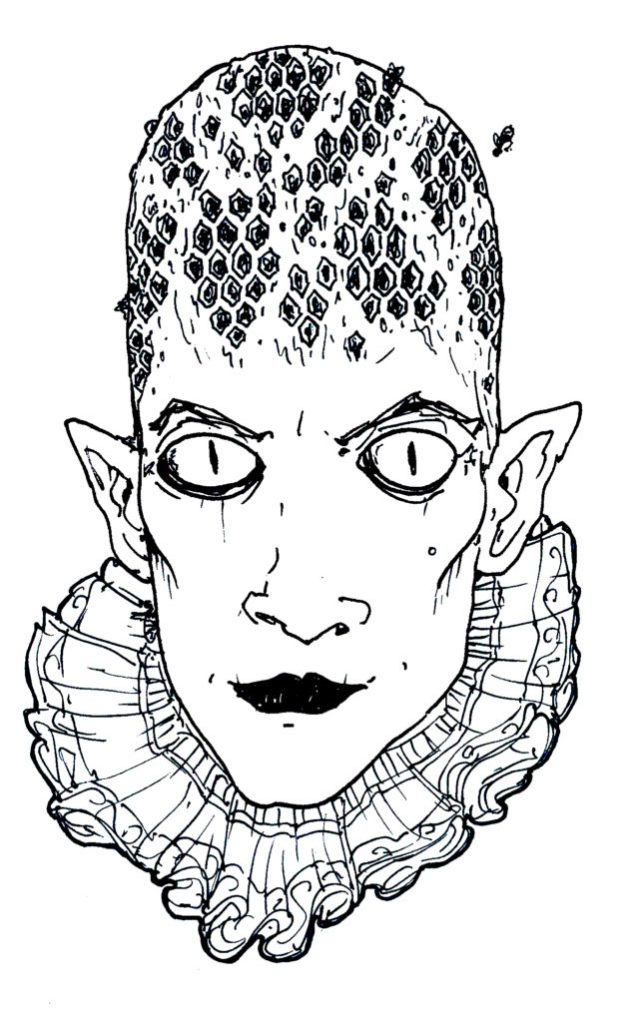 Alabastor and Garvin approach the sinister Duke of Bees: a thin, slender man with skin the colour of pale honey, standing beside a hulking warrior carrying his own head in his hands. The thin man was distinguished by the tiny holes in his bald head, honeycomb-like, from which crawl buzzing bees.
 Comet, meanwhile, was conversing with none other than Pieter “Wormbeard” Sluk: a hulking, amorphous creature with a body seemingly made out of semi-solid sludge that squelched through the room, although thankfully he did not leave a trail of slime – the mud seemed to be part of his body. A huge beard of fat, writhing earthworms the size of a forearm wriggled on his massive chin.


 Hurogg, a (vaguely) human barbarian of staggering size but seemingly dim wit. Hurogg has only joined the party briefly, but may return in future. Even in the short time he was present, hints of a strange past involving an alchemical accident have been uncovered. Hopefully the party will see Hurogg again; he has been glimpsed at times in Cephalus’ office and in other situations involving the dagonian barrister.


 Greengrin. Illustration by Caulis’ player,


 Golem Guard. Illustration by Caulis’ player,
  powerfully built man, human, of middle years, with jade green eyes that watched everything closely, hair black as midnight, and a bronze complexion covered in numerous arcane tattoos. He is known for his grim pragmatism, stern approach to law and order, military acumen, and conservatism.
 Arabella Sickle, a tall, voluptuous cambion woman, somewhat unfamiliar in the purple robes of the Council rather than the black and red regalia she wears as Hex’s Infernal Archbishop. Her huge horns gleamed in the magical light suspended above the six, and she worean expression of disdain. She is known for her ambition, her appetites, and her interest in aggressively expanding Hex’s power, influence, and colonial holdings. Perhaps most notable – her attempts to establish a Penal Colony in Hell, a measure repeatedly failed when it came to a vote.
 Iris Skewstone, also human, a surprisingly young-looking woman with hair that shifted colour every few seconds. She wore a pin of Umbral University on her robes. Iris is known for her radicalism, and her efforts – thwarted as surely as Her Unholiness’ desire for Hellish colonies – to extend suffrage to the non-magical citizens of Hex. She is attacked regularly in some corners of the press, alternatively as a manipulator, firebrand, extremist, or megalomaniac, but enjoys widespread support among Hex’s growing middle class.
 the world: an alchemist and entrepreneur of great skill and economic savvy, who built his fortune mass-marketing potions and homunculi to the rich of Hex and beyond. He is a rotund, jovial gnome whose skin is discoloured from numerous alchemical burns. Though spectacularly rich, he is beloved by those of the city’s working class capable of voting, and by many of the elite as well. His policies favour economic growth above all else. He is pro-trade, and averse to war save when profit can be made.
 Angus Loamson, reputedly a changeling, undoubtedly an eccentric, a former vagrant who wandered in from the Feypark. Angus – wild-bearded, crazed of eye, and smelling of the woods – insists that he speaks for all vegetal life. He pursues environmental policies with single-minded devotion and is a sworn enemy of the industries Barnabas. While widely dismissed as a crackpot, he was swept into office on the votes of homunculi and fungoids, amidst rumours of voting manipulation via magical slumber.
 Finally: Valentina Nettlecrave, a woman who looks even younger than the fresh-faced Iris, but whose porcelain perfection belies her true age. It is an open secret that Valentina is a lich, mummified and sustained by necromancy – easy to believe given her skull-pin of the Académie Macabre, indicative of her high rank at that sinister institution. Despite her likely illusory appearance as a doll-like girl barely beyond adolescence, she is renowned for her extraordinary wisdom and arcane knowledge. She is a wildcard, voting unpredictably, siding with various members of the Council at different times.
 Stenographer. Illustration by Caulis’ player,

 “Indeed. We are fond of you also.” Vespidae now led the way towards the Withered Tree, javelin in hand. The street called Badroot coiled around the Withered Tree, a street of husks both human and architectural. The emptied warehouses and eviscerated factories that lined the street were spattered with gang insignia and other graffiti, proclaiming the names of the clannish criminal factions like heraldry: the Parasites, the Dead Moles, the Whipstitchers, the Filthy Fingers, and the Graveyard Girls.
 “Who goes there, squawk, who goes there?” the golem demanded.
 Lunar Symbol by Matthew Murray.